Techno-Authoritarian Drift
Salient and Worrisome Trends
Neither funny nor about robots
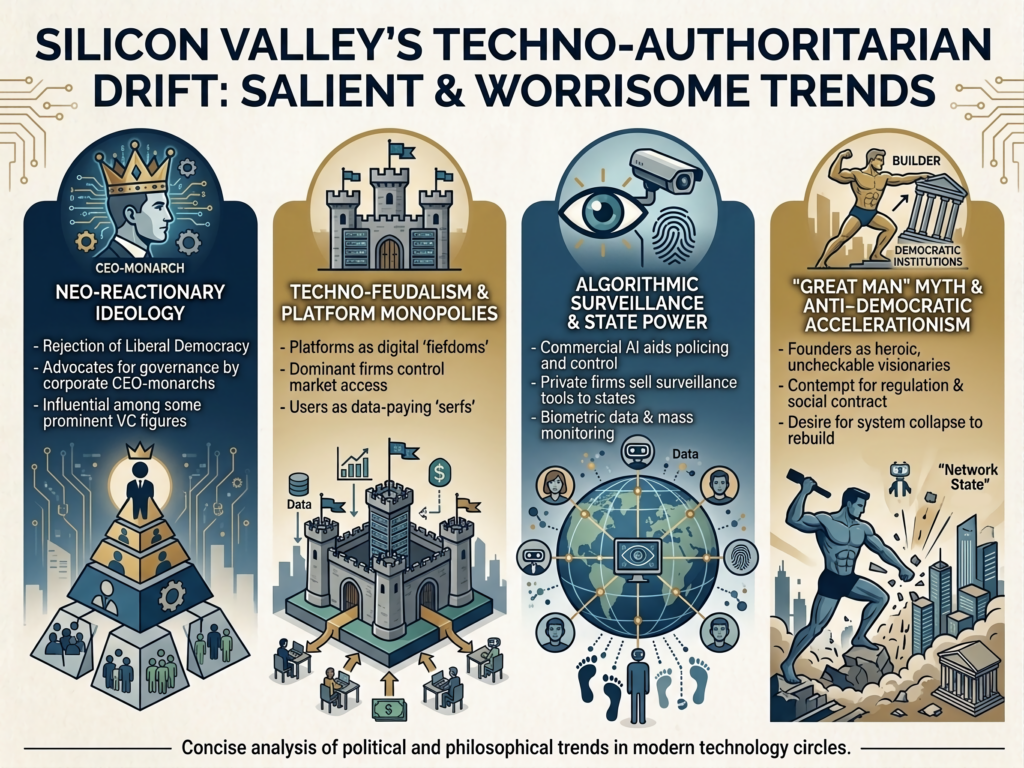
The political drift in tech circles away from classic internet-libertarianism toward explicit techno-authoritarianism has drawn significant scrutiny from political scientists, sociologists, and tech critics. While these figures often frame their visions as pragmatic, hyper-efficient, or forward-looking, several distinct trends align closely with classic and neo-fascist paradigms:
• Neoreactionary Ideology & the “CEO-Monarch” (NRx): Popularized by bloggers like Curtis Yarvin (Mencius Moldbug) and philosopher Nick Land, the “Dark Enlightenment” or NRx movement explicitly rejects liberal democracy. It argues that democratic systems are inefficient, terminally fragmented, and inherently decaying. In their place, NRx advocates for “neocameralism”—governing nation-states like joint-stock corporations led by an absolute, unelected CEO-monarch. This philosophy has gained quiet traction among prominent venture capitalists and tech founders who view popular vote as a barrier to technological progress.
• Techno-Feudalism and Platform Monopolies: Rather than fostering free-market competition, dominant platforms control the underlying digital infrastructure of modern commerce and discourse. Citizens and small businesses exist as digital “serfs” paying rent (data and platform fees) to centralized platform owners who hold sovereign-like control over digital speech, financial rails, and marketplace access.
• Biological Determinism and “Network States”: Influential tech figures frequently endorse ideas rooted in human heritabilities and technological elitism. This manifests in calls for “Network States”—gated, sovereign digital communities founded by tech elites that opt out of national tax systems, civil rights regulations, and social contracts to form self-governing enclaves for the technological elect.
• Collusion of Algorithmic Surveillance and State Power: The rapid integration of commercial AI, predictive surveillance, and biometric data systems into national defense and policing reflects a classic corporate-statist alliance. Private tech firms increasingly supply autocratic tooling—such as automated threat-detection, mass data scraping, and facial recognition—directly to state apparatuses to manage public dissent and control populations.
• The “Great Man” Myth and Anti-Egalitarian Cults of Personality: Tech culture frequently elevates founders as heroic, uncheckable visionaries who operate above public morality and standard legal frameworks. This worldview holds that society’s elite “builders” should dictate cultural and economic norms without friction from regulatory agencies, organized labor, or democratic consensus.
• Anti-Democratic Accelerationism: Rather than fixing institutional flaws, some tech elites advocate for intentionally accelerating the collapse of existing democratic institutions, public media, and civil infrastructure so they can build algorithmic alternatives on the ruins.