Record Review: The Reservoir Tape Heads (Self-Titled, 1983)
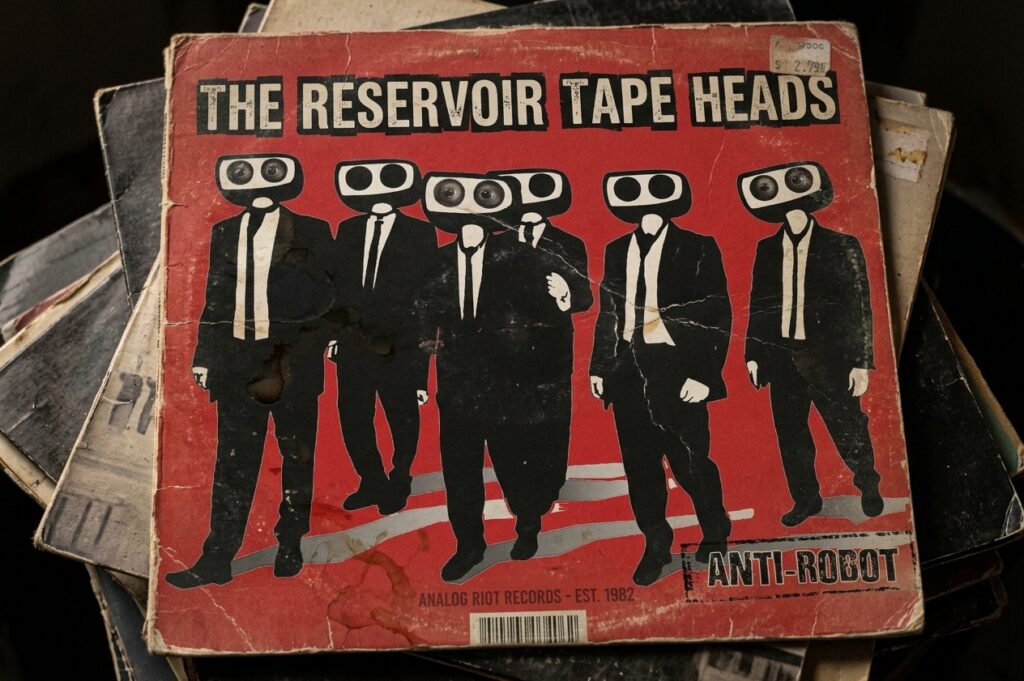
Label: Analog Riot Records
Rating: 2.5 / 5.0 (Musically) | 4.5 / 5.0 (Culturally)
Long before algorithmic feeds flooded the cultural landscape with synthesized homogeny, there existed a bizarre, fleeting anomaly buried in the bargain bins of 1983: the self-titled and sole LP by The Reservoir Tape Heads.
Positioned as the world’s first fully “automated” robot group, the band dropped a record that stands in hindsight as proto-AI slop—generated sound before AI slop was cool, or even technically possible. It is a work that feels less like artistic expression and more like an early computational model attempting to regurgitate the post-punk zeitgeist of the late 70s and early 80s through a wall of mechanical repetition.
The Sound: A Loop of “No Love Lost”
Musically, the album struggles with glaring derivative tendencies. The group’s mechanical architecture seems hardwired to a single reference point: Joy Division’s 1978 track “No Love Lost.”
Across all eight tracks, the basslines churn with that same angular, driving post-punk rhythm, while hyper-quantized drums clatter like a factory line running ten seconds away from a catastrophic breakdown. The guitars—if you can call those synthesized frequency bursts guitars—mimic the jagged, cold dissonance of Bernard Sumner, but without the organic desperation. It’s an endless loop of cold-wave tropes, endlessly repeating the same structural formula until the album feels less like a tracklist and more like an automated loop cycle.
The Vision: Scathing 1983 Social Commentary
Where The Reservoir Tape Heads fails in musical originality, it punches with terrifying precision in its thematic scope. Underneath the robotic droning lies a surprisingly pointed, scathing indictment of Reagan-era economics and the shifting socio-political reality of the early 1980s.
The band bypasses standard teenage angst to deliver a cold-blooded autopsy of modern American decline:
- Reaganomics & The Death of Labor: Tracks like “Morning in America (Decommissioned)” dismantle the era’s rosy political propaganda, juxtaposing glowing presidential speeches against the bleak reality of deindustrialization.
- The K-Car & Lee Iacocca: On the standout single “Chrysler K-Car Economy,” the band targets Lee Iacocca’s corporate bailout and the rise of uninspired, boxy utilitarianism, framing the budget automobile as a metaphor for a nation lowering its standards under corporate austerity.
- Cheap Credit as Wage Replacement: Perhaps their most prophetic take, the record obsessively critiques the birth of modern consumer debt. Lyrics mechanically chant about plastic credit cards stepping in to cover the gaps left by a stagnating working-class income—treating mastercard limits as a band-aid on a hemorrhaging economy.
- Foreign Policy & Imperialism: The haunting, metallic drone of “El Salvador ’83” abandons sarcasm altogether, delivering a chilling critique of covert Cold War interventions in Central America.
- Generic Grocery Apathy: Even the mundane isn’t spared; “Black Text on White Packaging” takes aim at the sudden proliferation of generic, unbranded supermarket products, equating plain-label “BEER” and “CORN FLAKES” with the aesthetic flattening of modern life.
The Verdict
The Reservoir Tape Heads is a bizarre contradiction. Musically, it is an exhausting exercise in copy-paste post-punk derivative work that proves machines lack a soul. But as a historical snapshot, its cold, unfeeling delivery accidentally serves as the perfect mirror for the era it critiques.
It remains a forgotten artifact of analog riot culture—a warning from 1983 that the future would be automated, derivative, and available for $2.99 in the clearance rack.