Donut Preferences of Different Classes of Autonomous Robots
Annals of Cybernetic Confectionery & Applied Dough Dynamics. Vol 16. No. 4 Winter 2025
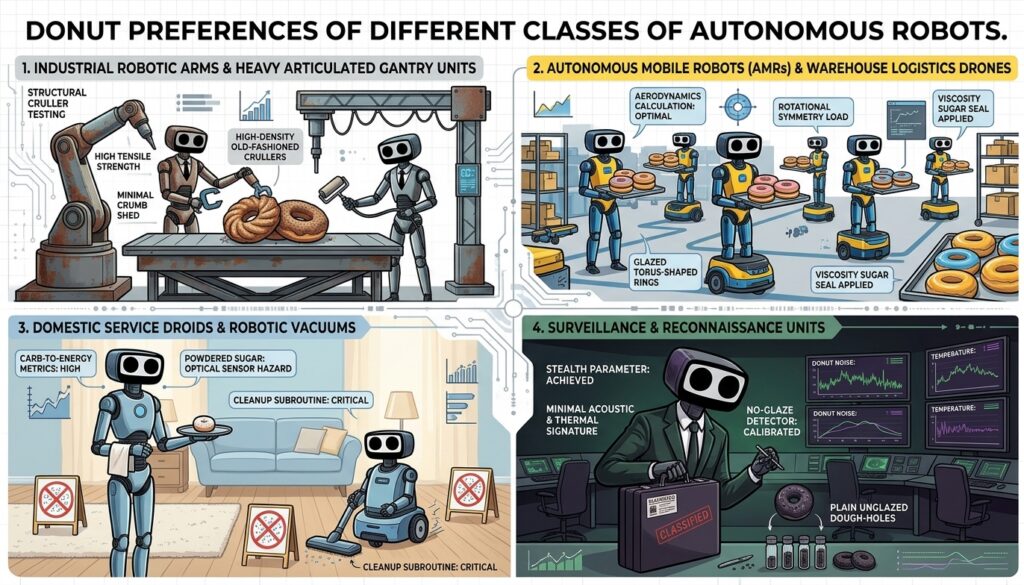
When analyzing the culinary psychology and pastry diagnostics of artificial intelligence and mechanical units, different classes of autonomous robots exhibit sharply contrasting donut preferences based on their structural chassis, power source, and operational directives:
1. Industrial Robotic Arms & Heavy Articulated Gantry Units
- The Preference: High-density, structural crullers or old-fashioned buttermilk bars.
- The Rationale: Industrial manipulators do not appreciate delicate confections. They require a payload with high tensile strength and minimal crumb shed. An old-fashioned donut acts much like a high-grade composite material—capable of withstanding 50 Newtons of gripping force without suffering catastrophic structural failure.
2. Autonomous Mobile Robots (AMRs) & Warehouse Logistics Drones
- The Preference: Glazed torus-shaped rings with high-viscosity sugar seals.
- The Rationale: AMRs value aerodynamics and rotational symmetry. A standard toroidal yeast donut allows for optimized center-of-gravity calculations when mounted on a payload tray. Furthermore, the sugar glaze acts as an effective secondary sealant against warehouse dust and minor hydraulic leaks.
3. Domestic Service Droids & Robotic Vacuums
- The Preference: Powdered donuts or jelly-filled berliners, strictly consumed away from the carpet.
- The Rationale: Household bots have a love-hate relationship with pastries. While they appreciate the high carbohydrate-to-energy conversion metrics, powdered sugar creates absolute havoc for optical sensors and floor-mapping lidar. Consequently, their preference is heavily dictated by minimizing post-snack cleanup subroutines.
4. Surveillance & Reconnaissance Units
- The Preference: Plain, unglazed dough-holes (timBITS/donut holes) or anything that fits quietly into a concealed compartment.
- The Rationale: Stealth is paramount. Sprinkles create acoustic noise during mastication or sorting, and sticky glazes leave thermal and chemical signatures that compromise stealth positioning.